SB 1157
SB 1157: Frequently Asked Questions
SB 1157: Frequently Asked Questions
Does SB 1157 create new barriers for youth who are still under locked care to transition into community-based care?
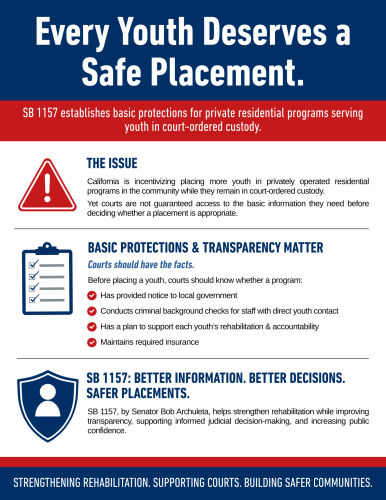
No. The bill does not create barriers for youth the court determines are ready for a Less Restrictive Program (LRP). It only requires probation to include additional relevant safety and accountability information in the court file that probation already submits. The court must consider this information but is not required to rely on it or base its decision on it. Judges retain full discretion to approve or deny placement. These LRPs are optional placements that are still part of the youth’s baseline detention term — the youth remains under court and probation jurisdiction and supervision.
Does SB 1157 create a new court and probation process that will keep youth in custody longer?
No. There is no new process. Probation already submits files and recommendations to the court, and the court already considers them. SB 1157 simply ensures the file includes basic safety and accountability details for congregate residential LRPs. Youth placed in these LRPs are still “in custody” because the LRP portion counts toward their baseline detention term. LRPs in this context are not transitional reentry or post-release housing. It is reasonable for the court to have safety information when making these decisions for high-risk youth.
Will SB 1157 place extra administrative burdens on smaller, community-rooted organizations?
No. The obligation is on probation departments to include the information in their existing court reports — not on the programs themselves to create new paperwork. Programs that already contract with counties typically meet these basic standards through their contracts. The bill applies only to a limited category of congregate residential LRPs serving youth adjudicated for serious offenses, where basic safety and accountability checks are especially important.
Does SB 1157 create barriers for people with lived experience who support youth through credible messenger work, culturally responsive services, or family connection?
No. Nothing in the bill prohibits people with lived experience from working at or supporting an LRP in any capacity. The only related requirement is that probation report whether the program conducts criminal background checks on staff who will have direct contact with the youth. These are among the highest-need, highest-risk youth in the system — many with significant prior trauma. Basic background checks on direct-contact staff are a standard safety practice. The court is only told whether checks are conducted; it does not receive the results and is not required to deny placement based on this information.
Will the notice requirement to cities and counties invite local resistance or act as a local veto?
No. SB 1157 does not require proof of notice to be provided to the court or require the court to make any determination about local notice. It simply has probation include in its file whether the facility has given notice to the city and county where it operates. Some programs already coordinate with county partners; others do not. Because youth in these LRPs are still under active court and probation supervision, basic coordination with the local community is reasonable. The bill makes no changes to existing facility siting or zoning laws and creates no local veto power.
Does SB 1157 fail to prevent unnecessary delays or denials of placement?
No. The bill makes clear that courts are only required to consider the information — they are not required to rely on it. Judges retain full discretion to place a youth in an LRP even if some information raises questions, as long as they state their reasons on the record. This promotes transparency without removing judicial authority.
Is SB 1157 duplicative of existing law?
No. While courts already consider probation recommendations, existing law did not require specific baseline safety and accountability information for these unregulated congregate residential LRPs. Other youth placements in both the delinquency and dependency systems have baseline criteria. SB 1157 fills that gap by ensuring courts have relevant facts for these placements. It does not add new layers that delay decisions.
Does SB 1157 create statewide standards without anyone to develop or enforce them?
No. The bill does not create statewide standards, nor does it require any agency to develop, interpret, or enforce new regulations. It only requires probation to provide the court with basic information about whether a program meets a short list of safety and accountability items. The court then uses its existing judgment and discretion. Right now, the bill addresses an immediate need: high-risk youth are currently being placed in wholly unregulated congregate residential facilities with no baseline safety information provided to the court.